Revisionism (part 5)

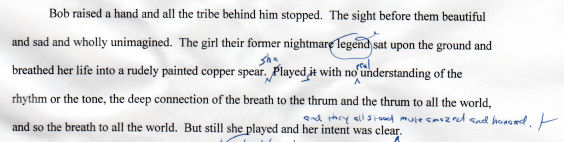
Here the focus changes to Bob, a centaur from Elegy Beach. Clearly the phrasing of the first sentence deliberately departs from a more standard, declarative narration. A flat statement would be “Bob raised a hand and the tribe stopped behind him.” Nothing wrong with that. But once again it’s a line that rises to the level of utility and no further. The interjection of rhythm into the sentence continues the sense of musicality, and I like that it lets the sentence and the action end on the word “stopped.”

There’s a sort of archaic tone to the line as well. I might as well just say that I want the narrative itself, not just the events it depicts, to rise to the level of myth. Whether or not it succeeds is in a way not really up to me. But to some extent I don’t really care about that. The point is to aim high. I’d rather do that and fall short than feel some satisfaction in the security of reiterating what everyone already does.

So after that comes one of my patented sentence fragments: “The sight before them beautiful and sad and wholly unimagined.” It’s funny, I can explain a lot about what I do to achieve certain effects, and why I go about doing it, even though I’m not really conscious of the underlying reasons at the time I do it (what, you think all this analysis goes on as I write this stuff? Good god no. That would be horrible). But I’d be hard pressed to explain why this sort of unpunctuated run-on fragment crops up all the time in my work. Lemme think about this a bit. But not too much.

So I cut “legend” out of the next sentence cuz it goes too far. One word too many, especially given the odd construction. Even with it out, the phrasing of “The girl their former nightmare sat upon the ground” demands a certain attention from the reader. It’s basically a dependent clause integrated into the sentence through the absence of punctuation. But if I’d set it apart the way most proofreaders would mark the thing up — “The girl, their former nightmare, sat upon the ground,” I’d end up with something that feels clumsy, with no rhythm whatsoever, and rendered merely descriptive. What an anvil drop of a sentence that would be. Argue about commas and people think you’re some kind of micromanaging OCD prima donna. But look at at the difference in that sentence without the commas. My loyalty is to the beauty or effectiveness of the sentence, not to its grammatical correctness.

Okay, so: Interestingly, I defragment the next line and render it grammatically correct. I think probably because too many fragments in a row starts to sound like a grocery list, but also because it’s a long sentence, and a long sentence fragment is kind of unfair, as the reader starts looking for subject/verb/predicate. (Well, initially readers look for these in short fragments, too, but I kind of teach them how to read me as I go. I don’t mean that to sound didactic, I simply mean that I try to ensure that the narrative provides clues to its interpretation: the cipher contains the decoder.)

Adding the word “real” doesn’t really add anything to the sentence in terms of meaning or focus — but it makes the rhythm more appealing (really). I changed this sentence still further later on.

I added a phrase to the last line because I didn’t like the clunky way it ended:  “and her intent was clear.” Clunk. I also didn’t like the way the narrative intrusion stood out. But “and they all stood mute amazed and honored” really wakes that sentence up, and doing it without commas causes a kind of image fusion, a connective association, between the words “mute” and “amazed” that wouldn’t exist if it were punctuated.  “They all stood mute, amazed, and honored” is just a list. There’s no music there. No resonance. No sense of mythic aim.

No poetry.

I won’t attempt to define poetry here (or anywhere). But I will say this: I want poetry in my prose. I want the poet’s sensibility present there. Because despite all the technique I’ve talked about, poetry isn’t in the words or their order or the way they are or aren’t punctuated. It isn’t in the sequencing and juxtaposition of images. It isn’t even in the meter or the sound. Poetry doesn’t happen on the page at all. It happens before the words ever get there. Because poetry is a way of looking at the world. It’s a lens that colors (or distorts, or diffracts, or magnifies) the language that goes through it.

What I’m talking about when I talk about writing or revision, when I vivisect those lines and show my tricks — elegant or shabby, obvious or invisible — is poetry.

Revisionism (part 4)

Here I’ve simply transposed the two sentences because the order makes better sense: She hears them coming and it spurs her to action. Now the sentences have momentum, whereas before the correction they were just a series of details.


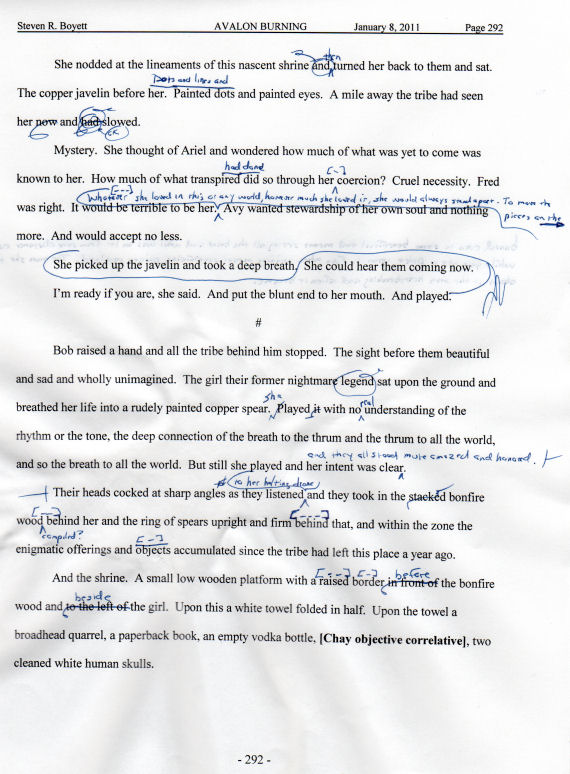
Note the absence of quotation marks in the dialogue following that. I hope my publisher doesn’t get too mad at me about this.  To be honest I’m torn about whether I should talk about why I avoid so much punctuation, because it just invites argument and distracts from the reasons why I avoid it in the first place. It would also have to be a separate post or two. I have to think about this.

Starting two sentences in a row with “and” isn’t something I’d usually do, and is definitely something best not done often. I did it here because it ends a section and leaves off on a note (literally) almost cinematic in its segue to the next sequence. Which we’ll get to tomorrow.

Revisionism (part 3)

Okeydoke, so above “did” I’ve got “had done” as an alt suggestion mostly because I’m questioning the tense in a recollective indirect discourse (which is when the narrative is simulating an internal monologue but remains outside the character, sort of looking over her shoulder).

That single bracketed underline after “her” — [_] — is my way of telling myself that I want a one-syllable word here. The sentence has a certain meter, and that’s partially why I’m looking at that tense change and that added one-syllable word. (If I read it out loud with the corrections the preferred meter becomes apparent:  “How much of what transpired had done so through her blank coercion?”)

I also welcome the opportunity to have a word that modifies “coercion” by rendering it either more specific or more evocative. It’s another example of how to leave your fingerprints on a page: Something like “dread coercion” or “glad coercion” (though neither of those is gonna go here) helps render a worldview, combines words not normally put in sequence to convey a more unique sensibility.

After “It would be terrible to be her” I’ve inserted a bunch of stuff to elaborate on the point, because the narrative is referring back to an exchange that’s a while back, and while it’s nice to think your readers have photographic memories (and to be honest, sometimes I do rely on an ability to remember an image or a certain sequence of words. The technical term for this is “trust”), when it comes to more abstract or conceptual details it’s sometimes a good idea to reinforce their presence when they show up again. I note that I’ve set a three-syllable marker [_ _ _] above “Whatever,” which tells me that I want another word besides “Whatever” here. The arrow at the end of the insert means I’ve continued the insertion on the back of the page.

A long time ago I adhered fairly strictly to proofreader’s marks and proper manuscript format regarding corrections. Now I realize that these notes are to me and no one else, and it made sense to evolve a kind of shorthand that would help me on revision. I use syllable markers and placeholders (if I bracket words in the MS it means I’m not sure about the words here and I should look for a better or more precise way of saying what the bracketed words say. Sometimes I redline), marginal notations like “awk” for “awkwardly phrased” or “cons” for “consistency” (meaning I need to search the MS to be sure the indicated details are consistent throughout). And so forth.

Revisionism (part 2)

So right off the bat I see “lineaments” and “nascent” in the first line. I think to myself, Okay, Steve, are you sure you want to fire them there big guns? And both in one sentence? Cuz the noise they make might drown out the other words there. And do you really want to send a percentage of your readers running for a dictionary? But “lineaments” is exactly the word that fits here. “Features” is too general, too imprecise, which is a shame because a two-syllable word there would maintain a better rhythm. (Listen to the beats:  “She nodded at the blah-blah of this nascent shrine.”) Same with “details.” “Characteristics” would pretty much own the entire sentence and turn any semblance of rhythm into something that sounds like sneakers in a dryer.

I like “nascent” because it’s a two-syllable word that fits the meter and says just what I want it to say. “New” would be ugly — a one-syllable word here would sound like when you’re going down a flight of stairs and you expect one more step but there isn’t one. “She nodded at the lineaments of this blah shrine.”  Whump! And it would create a possible implication that there’s another, older shrine, which there ain’t. What I’m going for here is “She blah-blah at the blah-blah of this blah-blah shrine.”

By now it ought to be apparent that the sound and meter of the words together are as important to me as what they mean or how concise they are. In Steve’s world, good writing sounds good. And I may as well just say it: In Steve’s world, sometimes how it sounds is more important than what it means.

Okay, so let’s look at the actual markings on that sentence. The stet version (that is, the version prior to marked correction) basically tells you “she nodded at this and turned her back.”  But that’s an implication of simultaneity, like “He walked and chewed gum.”  Whereas what I’m really trying to say is that she nodded, then subsequently turned her back. I have arguments with myself about ways to go about this. I could write what I just told you:  “She nodded, then subsequently turned her back.” If your view of fiction writing is that it’s basically a list of events, then that line is perfectly serviceable. In my view, if that’s your view of fiction, then you should write Ikea assembly instructions. Because however precise and concise it may be, it’s also ugly as hell. A turd in a punch bowl. I don’t want anything to do with it.

But once your criteria go beyond the utilitarian, the merely descriptive, you start having to make decisions. My choices here are basically “she nodded and then turned,” “she nodded, then turned,” and “she nodded, and then turned.” In my corrections I picked none of the above, opting for dropping both comma and “and”:  “she nodded then turned.” I know why I did it: The elimination of a comma and the word “and” gives the sentence a much nicer rhythm and flow. I also know that I’ve changed the correction on a subsequent revision because of the likelihood of the reader tripping on the word “then” without a helpful comma or “and then.” But what I won’t do here is put in a comma followed by “and” even if it’s grammatically correct to do so. Because it fucks up the way the sentence flows.

I’ll talk in a later post about why I drop a lot of punctuation. This post is already much longer than I’d intended.

Okay, so:  “The copper javelin before her.” I like the meter and I like the fragment. I use a lot of sentence fragments. Once again not grammatically correct. Once again I don’t give a shit. My loyalty is to the line itself.

Next sentence is also a fragment:  “Painted dots and painted eyes.”  I like the rhythm and I don’t mind the repetition of the word “painted.” Sure, taking the second occurrence out is more concise. It also takes all the air out of the sentence, and makes it unclear whether the eyes are in fact painted as well.

Above “Painted dots” I’ve drawn a line, and above the line is written “Dots and lines and”. This is my way of indicating an alternative. I’m leaving a note to myself that I might want the sentence to read “Dots and lines and painted eyes.” I can’t decide right now, but when I go to enter these changes into the computer, the decision is almost always clear to me. Sometimes you need some distance.

Okay, last sentence [insert thunderous applause]:  “A mile away the tribe had seen her now and had slowed.” Good god what a clumsy clunky sentence.  That “now” just sits there like a fart in church, don’t it? So I cut it.  I also cut the “had” but then changed my mind, both for the rhythm and the parallel construction. (I write “ok” instead of “stet” cuz it doesn’t take as long.)

So we started with this:

She nodded at the lineaments of this nascent shrine and turned her back to them and sat. The copper javelin before her. Painted dots and painted eyes. A mile away the tribe had seen her now and had slowed.

And ended with this:

She nodded at the lineaments of this nascent shrine then turned her back to them and sat. The copper javelin before her. Dots and lines and painted eyes. A mile away the tribe had seen her and had slowed.

Maybe the changes don’t seem like big improvements, or worth all this verbiage. But I think (or at least I hope) that if you read them out loud, you can hear the difference. (I’ll cheat and tell you that I reinstated a comma after “shrine” on the next pass.)

I’m sure I’ll get comments saying, I liked the first way better, or Why don’t you say it this way? I would like to pre-empt these by saying that my point is not to crowdsource my work but to try to present a kind of cross-section of the decisions I make in the revision process that contribute to an individual sense of style.

Revisionism (part 1)

When opportunity presents itself in a writing class or workshop, I like to teach a section on revision. I’ve never really seen a class devoted to revision, other than the ones I teach, and it surprises me, as I think revision is where the real writing takes place. And even if you think that first draft is the real creative nugget, it’s still important to know what to look for when you re-read the thing with an understanding that you intend to inflict it upon an unsuspecting world.

For classes, I like to print out a page of first draft onto a transparency sheet and revise with a Sharpie using an overhead projector. But as overhead projectors are becoming fossils in a digital world, I guess I will have to come up with some other way. It’s kind of a weird dynamic when I do this. I mean, I’m supposed to be an authority, teaching starry-eyed writers about Art and The Business, and all like that, and here I am basically standing in front of them in my underwear. Cuz that’s what first draft can look like. I’ve had students actually laugh out loud when they realize that I make some of the same dumb mistakes on first go-round that they do.

But I also think that’s one of the implicit values in the lesson — that professionals aren’t standing on some Olympian height creating perfectly polished prose on the hurling of a single thunderbolt of inspiration (though, okay, yeah, it happens like that sometimes). The idea is to impart the notion that one of the duties of a professional is knowing how to recognize and remove those mistakes, and how to re-read his own stuff with a view toward improving every word that’s there — cutting or expanding, rearranging lines, reordering words, substituting words for the sake of meter, drawing threads of theme and sound and image through the narrative, ensuring naturalistic dialogue, ensuring that the point of the scene is not lost, and much more.

So I thought it would be fun and maybe instructive to talk for a few days about how I revise. I’ll use a marked-up page from Avalon Burning, and I’ll try to explain why I made some corrections the way I did. In my view, all of these decisions are as contributory to the perception of style as the decisions that first put the words on the page. Maybe there’s an element in here that’s too much like a magician revealing how he does his tricks. I don’t know and I don’t care. This shit isn’t magic, it’s work. It’s not just a matter of just tell what happens, it’s a way of looking at language.

Here’s the marked-up page. I’ve revised it even further since, but we don’t have to worry about that now (though it might be fun to show how far I take it, maybe focusing on this one stretch of prose throughout the entire writing process. Hmm. Lemme think about that.). I’ll go over it a piece at a time in subsequent posts. If you think this is about as exciting as watching glaciers drag race, I won’t be insulted if you take a pass.

Some Odd Cool Things I Own

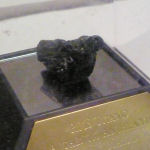
This is a piece of coal from the Titanic‘s debris field. Around 1994 a company called RMS Titanic, Inc., took out an ad soliciting pre-orders of these, claiming they would use the revenue to fund a scientific expedition to Titanic, and claimed the ship itself would not be disturbed. Then they promptly used the money to obtain sole salvage rights and sell berths on a cruise ship that sailed to the site, where passengers witnessed another ship the company had hired make a total botch of trying to raise a massive section of the hull, which promptly broke loose and planed back down far from where it had originally been.
Then they mounted a traveling exhibit of items they had pretty much indiscriminately raked up from the debris field. They charged admission, naturally.

I wrote them a really nasty letter because I felt my money had been ill-gotten and used for this debacle. And I admit I have really mixed feelings about the fact that I think that it is so cool that I own something from Titanic.

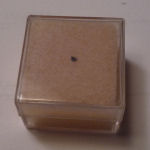
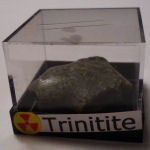
This is a piece of trinitite. That’s the name given to the desert sand that was fused into glass by the heat from Trinity, the world’s first nuclear detonation, in White Sands, New Mexico, in July 1945. So yes, I own an artifact produced by the first atomic explosion.  And no, I am not going to tell you where I got it, except to say that I did not buy it.

This is the Gregg Press hardcover edition of Samuel R. Delany’s novel Dhalgren. I’ve posted at length about the novel itself, but the short version is that Dhalgren is the book that made me want to write for a living. It has a pretty solid claim as science fiction’s first legitimate bestseller; as I recall over a million copies of the paperback original sold when it first came out.

But there were only 300 of the Gregg Press hardcovers produced. These puppies go for about $1500 nowadays — if you can find one. I didn’t buy mine. But I ain’t telling you how I got it. (Okay, okay: It was a present from someone who did some serious dickering & favor-trading to get hold of a copy.)

I have several books that would be hugely valuable if it weren’t for the fact that my books are read. I beat the shit out of them and I don’t feel remotely bad about it. But I wuv this thing. It’s my fav-o-rite material possession. You can’t have it.  Don’t even touch it. In fact, I think you’ve been looking at the picture a little too long now.

This is a fragment of the Zagami meteorite,a 40-pound hunk of rock that fell from the sky and into a cornfield in Zagami, Nigeria, in 1962. What makes it unusual is where it’s from.

A billion years ago, give or take a few, there was this piece of volcanic basalt just laying around on the surface of the planet Mars. Things went going pretty swell until about 2.5 million years ago, when a comet or asteroid slammed into the surface of the planet so hard that it blew chunks out of the atmosphere entirely — including our little basalt hero. It went tumbling through space for a couple million years and 35 million miles (give or take a few), until October 1962 when it  landed 10 feet away from a farmer in Nigeria. Gasses from veins of the original impact melt scattered throughout the meteorite matched the atmopsheric composition of Mars.

Yeah. I own a piece of Mars, beeyotch.

(A coda to Zagami’s long journey that I find absolutely wonderful: A little piece of the Zagami meteorite was only on Earth for 34 years — because a geology professor named Phillp Christensen attached it to the plaque on an instrument on board the Mars Global Surveyor. That’s right: He sent it back. Little Zagami is, best I can determine, history’s first recorded interplanetary round trip. And hardly anyone knows about it. That’s heartbreaking, I swear.)

Yeah, I know, this looks like the last picture. It’s a fragment of lunar tektite, a little sliver cut from a piece of impact ejecta that probably landed in Antarctica. Or, to make it simpler (and much more cool-sounding): I own a piece of the moon.
Of course it’s entirely possible these last two objects are crap some dude found in his back yard and shucked off on some sucker. But I bought these two items from a meteorite dealer, and all meteorite dealers have to trade on is reputation.

There are some other things I admit I really really want. One is a nice piece of cuneiform. I just think it’s amazingly cool to own a piece of the first writing. I don’t care if it’s a laundry list. I would go nuts if I had a protohominid fossil. A teacup from Titanic.

Some people have told me they think my passion for these things is dorky. Maybe so.  But I’d rather be a dork than be immune to the poetry of an object’s history.

Sign, Sign, Everywhere I Sign

The signature pages for the limited edition of Subterranean 2 arrived the other day, all 500 of em.  I spent two sessions putting my John Hancock on the dotted line.
I envy people who dash out some distinctive, elegant scrawl.  Not only does it look all grownup and fancy when they do it, but they can get through that stack of signature pages in about ten minutes. But something in me doesn’t understand a signature that doesn’t look like the name it represents. My signature clearly says Steven R. Boyett. I think maybe I’m unimaginative.

My signature is also laughably ornate.  I sign it very slowly, and if I think about it too hard I swear to god my hand mutinies and I make some mistake.  It takes forever for me to get through these pages.

In my twenties my signature was hilariously over-the-top girlie.  It had loops and curlicues and looked like some kind of wireframe sculpture of a rollercoaster.  It took me about a day and a half to sign it.  Then I did my first stack of signature pages, for Dave Schow’s Silver Scream anthology.  It took me about four hours to sign 500 pages and my left hand was killing me by the end of it. That was the end of that: I set out to change my signature.

What I ended up with looked a lot different and was faster to sign, but still light years from some quick and distinctive scrawl. Oh, well.

Walking the Walk

For some reason most of my published books and longer works are walking quests. By that I mean that an individual (often accompanied by a nonhuman companion) sets out on foot to cross a lot of real estate toward some objective.  In the course of his travels he usually undergoes death and resurrection (symbolic or literal), and part of his journey takes place on water (replaced by the resurrected Goodyear airship in Elegy Beach).
This holds true for Ariel, The Architect of Sleep, Elegy Beach, The Gnole, the forthcoming Mortality Bridge and Avalon Burning, my novellas “Prodigy” and “Like Pavlov’s Dogs” — in other words, every longer work I’ve published. (But it isn’t true for longer works I haven’t published. Hmm. Maybe I just learned something important here.)

In these works the landscape is usually stripped bare — not of vegetation or wildlife (though sometimes that’s true too), but of civilization — and most of the rules of society have either been broken or made irrelevant. In this my work has a fascination with what have been called Temporary Autonomous Zones, places where normal law, infrastructure, and hierarchy have been suspended. Except in my case they tend not to be temporary.

Interestingly (well, to me, anyhow), this is true for me in the real world as well. Burning Man and the Northern & Southern California Renaissance Faires of 15 to 20 years ago have held great significance in my life.

I sometimes go to great lengths to ensure that my characters must walk to their goal. Driving, bicycling, rollerblading, waving magic wands, or saying giddyup to your centaur buddy pal are just out. I think my reason for this is in line with my view of Grail quests in general:  ya gotta earn yer friggin Grail, pal. You don’t drive to it, you don’t win it in a goddamn lottery. You could, I suppose, but it wouldn’t mean a damn thing to you if you did. I believe (with conviction that sometimes surprises me) that Grails take their careful measure out of your heart. That the price you pay to attain your Grail is always at least the value of the Grail itself. I believe that this is the entire point of grails in general. They are not supposed to be a bargain. He who buys a bargain Grail buys tin.

Another reason I love Walking Stories is because they are a literal (and hopefully literary) embodiment of the adage that “it’s not about the destination, it’s about the journey.” To me, what the destination itself eventually means is shaped by the journey.

The nonhuman companion in these things seems to function (at least partly) as an idealization of some human component — love in Ariel, friendship in The Architect of Sleep, duty in Elegy Beach, loyalty in Avalon Burning. Maybe they’re variations on Jiminy Cricket, I dunno. I am aware that one of the great pleasures and powers of fantasy fiction is that metaphors can be manifest. (I’m also aware that when these metaphors are obvious it’s a Bad Thing, which is why I loathe every word ever perpetrated by C.S. Lewis.)

Do we pick our themes and obsessions? Man, I don’t know. I don’t really even know where they come from.  What I do know is that Stephen King’s The Stand and The Long Walk, The Odyssey, The Inferno, The Lord of the Rings, Don Quixote, Gene Wolfe’s Latro books (Soldier of the Mist, Soldier of Arete, Soldier of Sidon) and his Book of the New Sun tetralogy, Heinlein’s Glory Road, all of Cormac McCarthy’s Western novels and The Road, Delany’s Neveryon books, and I’m sure many more struck resounding chords in me when I read them — whether I encountered them in elementary school or last month.

Update: Subterranean: Tales of Dark Fantasy 2

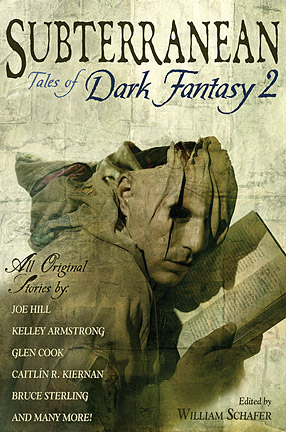
Here’s the cover for Subterranean: Tales of Dark Fantasy 2, which will contain my first published short piece (a novelette of approx 30,000 words) in at least a decade, “Not Last Night but the Night Before.”  Cover art is by Dave McKean.

Subterranean Press will publish a limited, 250-copy, signed & numbered, leatherbound & slipcased hardcover edition that features full-color art not available in the trade edition, along with a chapbook of two original Joe Lansdale stories. The trade hardcover will be clothbound. Subterranean publishes beautiful, high-quality books that are prized by collectors; I can’t wait till this (and, of course, my novel Mortality Bridge) comes out.

Publication date is now April 2011. I’ll post an excerpt from “Not Last Night….” before then.

AVALON BURNING Excerpt in New Urban Fantasy anthology

Jacob Weisman of the wonderful Tachyon Publications has picked up an excerpt from Avalon Burning for an upcoming urban-fantasy anthology edited by Joe Lansdale and Peter Beagle. The 7500-word story is called “Talking Back to the Moon,” and will be published in August 2011. No cover or word on other contributors yet (this just happened), but I will definitely keep you posted.

This story concerns Avy’s run-ins with some wild creatures near Griffith Park in the San Fernando Valley, and her conflicted relationship with the wildness in the outside world and inside her as well.

I’m excited about this, and delighted that a preview of Avalon Burning will be available.

A Little Help from Cory’s Friends

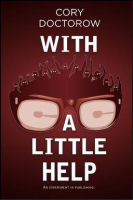
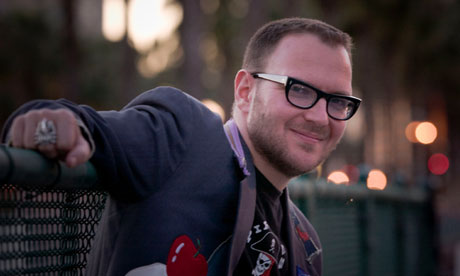
Cory Doctorow’s story collection A Little Help from My Friends was published this week.  Cory is a columnist, blogger, science fiction writer, crusader for adoption of new copyright laws and business models (known as copyleft), and one of the best public speakers I’ve ever heard. He was the first writer to digitally release a freely shareable novel (Down and Out in the Magic Kingdom) under Creative Commons license at the same time it was released commercially in print.

A Little Help is Cory’s DIY experiment to produce, distribute, and sell a bound book without the use of a commercial publisher at any step in the process. He is also giving it away in downloadable digital form. For years Cory (along with others, including yours truly) has been arguing that current digital technology enables artists to produce and distribute their own work in a way that, while admittedly is without the resources and revenue-generation currently possible through established corporate publishers, lets the writer control every aspect of the work and keep every penny it generates.

Cory reported on his experiences producing A Little Help in Publisher’s Weekly. His experience has been invaluable and instructive to modern writers for a number of reasons.  First, it demonstrates that it’s perfectly possible to do the whole enchilada yourself (or rather, employing the resources of yourself and a lot of other people; thus the collection’s title), which is encouraging to writers. Second, it demonstrates that art direction, cover design, printing, packaging, distribution, and accounting, are really hard and take a lot of work, which is good for publishers.

Currently, if you are a writer, to go the DIY route means you have to really really want it. Cory proves it’s possible to make money on a self-produced work and give it away at the same time. He also proves that publishers are still relevant and valuable.
I believe that this process will only become easier for writers, and that corporate publishing will remain strong but will evolve into what is essentially a service industry, offering to take the burden of self-production from writers in exchange for a hefty portion of the profits — pretty much what publishers do now, except that historically the writers themselves have not been their competition, and that is about to change. But competition is good, and will force publishers to strengthen and stress what they offer a writer as an alternative to that writer’s increasing, and increasingly powerful, DIY options.

I admire Cory Doctor greatly.  He lives on a battlefield that, in truth, I really only visit a lot. He isn’t just out there talking about the need to develop new business models and adapt to them, he is developing them. He is a one-man existence theorem, demonstrating the viability of an idea by being an example of what it describes. I hope that you will help support him in his pioneering efforts.

New Novel — MORTALITY BRIDGE

I’m delighted to announce that Subterranean Press will publish a limited-edition hardcover of my latest novel, Mortality Bridge, in late 2011.

Mortality Bridge is a dark and lyric fusion of Orpheus, Faust, The Inferno, and Robert Johnson’s “Crossroads” myth in which a blues musician travels to Hell to take back his wife’s purloined soul.

It’s kind of hard to convey what getting this book published means to me. I’ll just go ahead and say that I think this is the best thing I’ve ever written, and the hardest. (I once described it to someone as “Terry Gilliam’s film of Orpheus starring Bruce Willis, with a soundtrack by Eric Clapton and a screenplay by Cormac McCarthy.”) It was a looooong time coming, and I can’t wait until it’s published.

The Subterranean edition will feature cover art by Vincent Chong.

I will most definitely be posting more about this as publication nears.

Home of the Rave

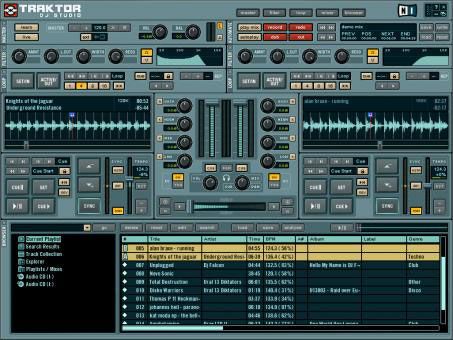
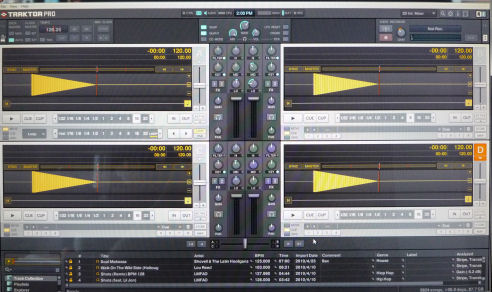
Total last-minute gig:  I’m playing a free Burning Man decompression-style party in a winery warehouse in Napa Valley tonight. Except for my brief gig at the Rellik, which doesn’t count, I haven’t played out since moving to Northern California earlier this year. I’ll be playing a ton of funky house & breakbeat, probably moving on to bigtime progressive house as the night moves on and things get wacked. I’ll be tag teaming with another DJ as well — this should be a ton of fun, and I’m stoked.
But it also means a lot of scrambling, because I recently converted from an old version of my Traktor DJ software to a totally new version, and upgraded a ton of equipment. Unfortunately my ancient Sony gigging laptop won’t handle the new Traktor, which means I have to update playlists, massage tracks, and then practice on it using the MIDI controller I used with it as well — all of it glorious for years, and now sadly feeling kind of long in the tooth.

I’m amazed how quickly a whole new set of reflexes and kinesthesia can be acquired. I hope to be just as amazed how quickly they can be reacquired as I practice today.

I’ll record the gig, and hopefully put it (or at least part of it) online as a Groovelectric mix. kEwLz!

Life Imitates Art Dept.

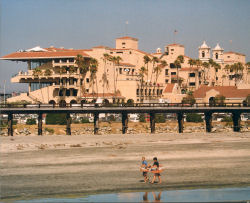
On New Year’s Eve, DJ Ferry Corsten will be headlining a huge rave at the Del Mar racetrack in Southern California. Corsten isn’t really my thang — he’s a trance DJ, while I go for funky house, progressive house, & some tech house (and, curiously enough, I saw him on NYE a few years ago, following John Digweed, Who Is God)  — but I’m still loving this, because Chapter 13 of Elegy Beach (text here, audio here) is essentially a post-apocalyptic fantasy rave (called a “vibe”) at the Del Mar racetrack.

Only two things could make this any cooler:

1.  Someone who has read Elegy Beach goes to Del Mar racetrack on New Year’s Eve and has a total hallucinogenic deja vu moment, or

2. I somehow end up DJing at Del Mar.

Okay, universe, I just sent up a flare….

There’s a weird kind of sympathetic magic that happens to me when I recontextualize a real place in a work of fantasy. It’s as if from then on I have artificial memories of impossible events that happened there. I know where the pre-Change bubble is on I-5 coming down into the California San Joaquin Valley. I know how the Water Court in downtown LA’s Bunker Hill ends up being used in Avalon Burning, and what confrontation took place in the ruins of CityWalk in Universal City. Which metal projection on the Empire State Building Pete grabs onto for dear life in the hang-glider sequence in Ariel. Where the pentagram is drawn on the dried pool beneath the tennis courts at Hearst Castle. The canal where Pete saw the manticore. Where the Goodyear blimp Spirit of America came down at the Tejon Pass. The spot on the bridge where Fred and Yan stop the Surfliner car between Del Mar racetrack and the ocean. Where the cornfield is in the Biosphere that gets raided by zombies in “Like Pavlov’s Dogs.” Where the entrance to Hell is in the upcoming Mortality Bridge (more about that in a future post).

Having a laminate of the impossible that can be placed atop the concrete world is one of my more obvious trademarks. It’s also just way cool. And when something happens in the world after I’ve written about it in some impossible context — yowza.

SF in SF Reading (pt. 1)

Last Saturday’s reading at SF in SF was an enormous amount of fun. Thanks to everyone who attended, and thanks to the wonderful Terry Bisson for hosting and interviewing, and to Rina Weisman and all who put together this splendid series.

I recorded the evening and will present the audio in three parts: Reading from Elegy Beach, reading a short story called “I’m Sorry to Have to Tell You This,” and the subsequent Q & A with me and co-reader Dale Pindell.

I also conducted a brief interview with Rick Kleffel of The Agony Column. He is an amazing interviewer, and I will post links when it is online.

SF in SF Reading – ELEGY BEACH Chapter 3:

[audio: http://www.steveboy.com/audio/boyett_-_elegy_beach_(reading).mp3]

Download: Boyett – Elegy Beach (reading) [16:12]

“Myopia” – Keynote Speech – LJWC 2010

This came about as a result of my bluff being called by Jared Kuritz, Director of the La Jolla Writers Conference.
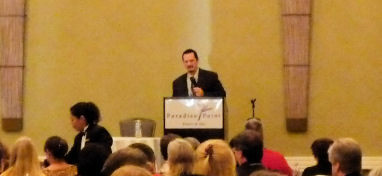
James Frey had originally been slated for the keynote. Frey gained infamy when his ostensible memoir A Million Little Pieces was exposed as almost entire fabrication — after he had gained the Oprah Seal of Approval and been on her show to tout his own writerly sensitivity. Frey later claimed to have knuckled under to pressure from his publisher and agent, and as it was his first published book and he was on uncertain ground, he went along with it.

Perhaps that’s true, but there had to have been a point (more likely dozens of points) where Frey realized he was going to have to pile lie upon lie to make this work, and anyone with an ounce of integrity (or at least some kind of admirable quality) would have copped to it, apologized, and moved on. Instead Frey lied until it was irrevocably proven that he made it all up, and then his response was to say, But they made me do it!

In any case Frey not only studiously avoided many opportunities to become a vertebrate, he essentially made a career out of crying mea culpa and then exploiting that very exploitation.  I had a real problem with this and basically told Jared that I intended to walk out of Frey’s speech (I didn’t tell him that I was also going to do my best to get a lot of people to walk out on it as well.)

Then I saw that Frey was teaching a course at LJWC on generating controversy as a PR device. I went ballistic. I called Jared. How the hell can you have this charlatan teaching your students? What kind of light do you want to shed on the rest of the hardworking teachers who bust their ass to bring you a solid curriculum? Jared just laughed and said, “I’m pretty sure he’s gonna flake. I’ll give you the keynote when he does.”

Riiight. You’re on, I say. Safe bet, right? Then Frey flakes. (And this is before this week’s wholly justified pillorying and comeuppance regarding Frey’s Draconian story mill.)

So I scrambled to add another class and the keynote to my LJWC schedule. And because the students at LJWC are really good, and generally well along in their abilities — they got chops, folks — I wanted to avoid the platitudinous cheerleading speeches I usually hear and talk about stuff I wish I’d known when I was first starting out.

The result was “Myopia” — hardly my first speech, but my first keynote speech. I was (and remain) pleasantly startled by the reaction to it. One of the best compliments I’ve ever received was from conference organizer Antoinette Kuritz, who said to me (you can hear it at the tail end of the recording) that she wanted to send Frey a copy of the speech and thank him for canceling.

So thank you, Jared, for calling my bluff. And thank you, James Frey, for flaking.

[audio: http://www.steveboy.com/audio/boyett_-_myopia_(ljwc_2010_keynote).mp3]

Download: Myopia (LJWC 2010 Keynote Speech) [27:45]

The Writer as Performer – LJWC 2010

Here’s the last of my classes from this year’s La Jolla Writers Conference. I found it ironic that “The Writer as Performer” was the least attended of my courses — maybe writers just don’t want to be performers? Well, live & learn.

Next up will be “Myopia,” my LJWC keynote speech.

The Writer as Performer
The book may be over when you type “the end,” but your job  as a professional writer has only just begun. Our media-saturated world is crowded with entertainment clamoring for attention. Like it or not, one of your jobs as a professional writer nowadays is to direct some of that attention toward you and, by extension, your work. We’ll discuss avenues and techniques for presenting yourself and your work, including readings, interviews, teaching, public speaking, online presence, and more.

[audio: http://www.steveboy.com/audio/boyett_-_writer_as_performer_(ljwc_2010).mp3]

Download: The Writer as Performer [01;44:30]

Arm’s Reach – LJWC 2010

I tend to separate classes into practical and craft. That is, into courses that offer pragmatic, real-world information for leading a writing career that I don’t see offered anywhere near enough in writing programs, all too often resulting in starry-eyed dreamers getting whammed with the baseball bat of The Way It Really Is Out There; and courses that deal in technique and theory and approach to learn style and voice and all kinds of elements of writing.

This is one of the practical ones.

Arm’s Reach: What You Should Have On Hand to Lead a Writing Life
This class will not discuss art and craft, but will focus on the practical aspects of living life as a professional writer. What tools should you have on hand? What methods for organizing should you use? How do you deal with taxes and deductibles? What resources should be immediately available to you? Ideally you should be able to sit at your desk and have most of the tools necessary to live as a writer in arm’s reach.

[audio: http://www.steveboy.com/audio/boyett_-_arms_reach_(ljwc_2010).mp3]
Download:  Arm’s Reach: What You Should Have On Hand to Lead a Writing Life [52:44]

Soliloquies & Self Indulgence – LJWC 2010

Next up from the La Jolla Writers Conference series of class lectures is one I’ve been wanting to teach for a long time, because it’s all about purty writin’. I dunno if there area  lot of places you can run a two-hour class devoted entirely to lyric prose, but I’m all over it when the opportunity arises. Audio follows the course description.

LJWC Class re-creating The Last Supper

Soliloquies and Self Indulgence — It’s been said that writing fiction isn’t really all that hard: you simply list what happens. If you believe that fiction is about only its events and not also about the beauty of the words themselves, then this class isn’t for you. We will look at meter, image fusion and juxtaposition, “pure” narrative, indirect discourse, and other techniques and choices used by writers such as Cormac McCarthy, Jack Kerouac, James Joyce, Shirley Jackson, and others to create prose that is as musical and poetic as it is functional.

Download:  Soliloquies & Self Indulgence [01:52:02]
[audio: http://www.steveboy.com/audio/boyett_-_soliloquies_and_self_indulgence_(ljwc_2010).mp3]

Reading @ SF in SF

Just a reminder that I am giving a reading tonight at SF in SF. Details below.

SF in SF
Saturday, Nov. 13, 7:00 PM
The Variety Preview Room
582 Market Street at Montgomery
(first floor of the Hobart Bldg.)
San Francisco
(map)

Reading @ SF in SF

I will be reading at the SF in SF (Science Fiction in San Francisco) series on Saturday, November 13. I’ll read a selection from Elegy Beach and a brief short story, “I’m Sorry to Have to Tell You This.” This is my first reading in the city since moving to the Bay Area earlier this year, and I’m really looking forward to it. If you’re in the SF Bay area, come say hi!
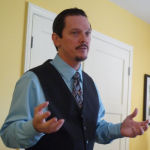

Doors open at 6:00 PM; readings begin at 7:00, followed by Q & A. Borderlands Books will have Ariel and Elegy Beach there for purchase. Proceeds from the cash bar benefit the Variety Children’s Hospital.

SF in SF
Saturday, Nov. 13, 7:00 PM
The Variety Preview Room
582 Market Street at Montgomery
(first floor of the Hobart Bldg.)
San Francisco
(map)

New Roles for Writers – LJWC 2010

No, really--my book is THIS big.

This is a kind of continuation of last year’s interactive lecture on New Media Alternatives to Traditional Publishing. I get the feeling that a survey of the changing roles and outlets for professional writers will be part of what I do at LJWC every year.

Because I did view it as a continuation, it took me a while to realize that there were students who wanted a more fundamental understanding of events and options. From now on I think I’ll start from a more solid foundation and then build. Yeh.

Course description:

New Roles for Writers: Keeping Current in the Digital Age
The extreme changes wrought by digital technology across all media have finally begun to wreak havoc across the publishing landscape. A writer’s options and obligations are both transforming and expanding. The traditional models still exist, but they are starting to be but one voice among many clamoring for attention. Writers who cling to traditional publishing models as the way things have to be are tantamount to polar bears stranded on ice floes created by global warming. Denial is limiting and even destructive. This interactive lecture will examine current publishing trends and options, skills writers will need to develop in the digital age, and directions publishing may take in the next few years. Where will you be when the dust settles?

[audio: http://www.steveboy.com/audio/boyett_-_new_roles_for_writers_(ljwc_2010)]

Download:  New Roles for Writers [01:51:10]

Full Contact Faculty

I’ve posted here before about how clumsy I am. This last weekend at the La Jolla Writers Conference was no exception, and very publicly so.

First morning:  I like to dress well at these things, for any number of reasons not relevant here. I like to start nice but casual and kind of work my way up as the weekend progresses. So for my first day I wore a vintage silk tan & black guayabera shirt with black cotton pants, brown skate sneakers, and my brown porkpie hat. It’s 83 degrees in La Jolla in the middle of November and I’m in some demented California designer’s hilariously awful notion of a Polynesian resort. Perfect.

Among the many favors the ostensible resort bestows upon its guests (including locking the ice machines at night, not having coffee available in the rooms until this year, and charging a la carte for virtually everything, including Internet access) are flimsy coffee cups with joke lids. In the faculty lounge I take a drink of coffee at the same time someone across from me takes a drink of his coffee. He’s wearing a white polo shirt. Both of us spill coffee all down the front of ourselves. There’s no club soda to be had anywhere (the front desk recommends the restaurant, wholly unaware that the restaurant isn’t open), so I just have to live with it and go to class looking like I’ve barfed on my nice shirt.

Only I have somehow also cut my forearm, and at some point I have wiped my forehead with my arm. So basically I taught my first class with a massively stained shirt, cut arm, and bloodstreaked forehead, looking like I’d just wandered in from some entertaining brawl.

Next morning I’m barely awake (remind me not to let anyone schedule me for 8 AM classes ever ever again), barely caffeinated, and wearing my deep blue pinstripe three-piece. I get to class, leave my stuff on the table set up in the middle of the U of student tables, and realize I forgot to get myself a bottle of water. As I’m leaving I realize I should be sure my digital recorder is set up.  I pull it from my pocket as I walk around the tables and glance back at my stuff, then turn forward and walk headfirst into a plate glass window.

Rather unbelievably, the window doesn’t break.  And I don’t even feel that my head hit the thing. For some reason I think it’s my shoulder. I go get a bottled water and hurry back and get into my little middle section to teach. Everyone’s staring. “What?” I ask. Someone points to his nose. I put my hand on my nose and it comes away soaking red. My nose is bleeding profusely across the bridge. I also have a decent goose egg on my right supraorbital ridge. Christ.

I run into the bathroom, get some napkins, and dab at my nose, then hurry to teach the class.  A two-hour lecture on lyric prose. When it’s over I go to check the damage in the bathroom and see that my nose is covered with blood on top. I’ve just taught a 2-hour seminar on purty writin’ looking like the bad end of a mugging. It’s a credit to the students’ perspicacity and diplomacy that no one said a word. I dunno how they did it.

“Writing After Work” – LJWC 2010

Nothin up muh sleeve -- presto!

Just back from this year’s La Jolla Writers Conference and a jam-packed three-day marathon of teaching, as well as a wonderful time spent talking to students and faculty.

I recorded all classes and my keynote speech, and I’ll post them here over the next week or two. Here’s the first, along with its course description.

Writing After Work:  Balancing a Job and a Career
Many writers think they can kiss their day job goodbye after that first sale. The real world often begs to differ. Learning how to balance a day job and a writing career is necessary before your first sales, but it may be necessary for a while afterward, too. This class will look at ways to budget time, scheduling, and dealing with some of the conflicts that arise between job and writing career.

[audio: http://www.steveboy.com/audio/boyett_-_writing_after_work_(ljwc_2010).mp3]
Download: Writing After Work [55:28]

Henceforth

The following Words are hereby decreed Illegal in the Titles of Works of General Fiction and Literature:

  • Bone / Bones
  • Club
  • Whisperer
  • Dead
  • Society
  • Wife [when defining a Female according to the Occupation of her Husband, e.g. ,The Emperor’s Wife]
  • A Novel [when preceded by a colon]
  • [Any Deceased Author]

Furthermore, it is henceforth Forbidden to have as a Protagonist any sort of Writer, or other Practitioner of the Arts plainly substituting therefor.

The following Words are hereby decreed Illegal in the Titles of Works of Science Fiction:

  • [blank]-World
  • Effect
  • Empire
  • Zone
  • Factor
  • Chaos
  • Hegemony
  • Galactic

The following Words are hereby decreed Illegal in the Titles of Works of Fantasy:

  • Chronicles
  • Dragon
  • Lord
  • Quest
  • Shadow
  • Wizard
  • Apprentice
  • King
  • Empire / Emperor / Empress
  • Prophecy
  • Doom
  • Throne
  • Sword
  • Saga
  • Rune
  • Covenant
  • Bane
  • Mage

Further, the use of a Colon in the Title of a Science Fiction or Fantasy Work shall be by Royal Approval only, and shall never accompany an Unpronounceable Neologism (e.g., Sword of Prophecy: The Fyrblyngkan Chronicles).

Furthermore, for Works of Science Fiction or Fantasy, it is henceforth decreed that Writers must show Due Cause for any Narrative Exposition, or else remove such Offending Material from Public Scrutiny prior to Publication.

The following Words are hereby decreed Illegal in the Titles of Works of Horror:

  • Dark
  • Blood
  • Death
  • Moon
  • Scream
  • Fear
  • Any gerund [word ending in ing, e.g., The Gnoshing]

Further, it is henceforth Forbidden to Invoke the Deity in the Banishment of any perceived Evil, unless Fair and Timely arrangement of adequate Payments of Royalty have been previously Arranged.

LJWC Update

My class schedule at the La Jolla Writers Conference on November 5 – 7 has changed a bit.  One class has moved from Saturday to Sunday, and I am now giving a keynote speech and another workshop.

Here’s the amended (and final) version:

Friday, November 5
2:00 – 3:50
New Roles for Writers:  Keeping Current in the Digital Age — The extreme changes wrought by digital technology across all media have finally begun to wreak havoc across the publishing landscape. A writer’s options and obligations are both transforming and expanding. The traditional models still exist, but they are starting to be but one voice among many clamoring for attention. Writers who cling to traditional publishing models as the way things have to be are tantamount to polar bears stranded on ice floes created by global warming. Denial is limiting and even destructive.  This interactive lecture will examine current publishing trends and options, skills writers will need to develop in the digital age, and directions publishing may take in the next few years. Where will you be when the dust settles?

Saturday, November 6
8:00 AM – 8:50 AM
Arm’s Reach: What You Should Have On Hand to Lead a Writing Life — This class will not discuss art and craft, but will focus on the practical aspects of living life as a professional writer. What tools should you have on hand? What methods for organizing should you use? How do you deal with taxes and deductibles? What resources should be immediately available to you? Ideally you should be able to sit at your desk and have most of the tools necessary to live as a writer in arm’s reach.

9:00 AM – 10:50 AM (ADDED)
The Writer as Performer — The book may be over when you type “the end,” but your job  as a professional writer has only just begun. Our media-saturated world is crowded with entertainment clamoring for attention. Like it or not, one of your jobs as a professional writer nowadays is to direct some of that attention toward you and, by extension, your work. We’ll discuss avenues and techniques for presenting yourself and your work, including readings, interviews, teaching, public speaking, online presence, and more.

12:30 PM – 1:00 PM (ADDED)
Keynote Address:  “Myopia”

Sunday, November 7
9:00 AM – 10:50 AM
Soliloquies and Self Indulgence — It’s been said that writing fiction isn’t really all that hard:  you simply list what happens. If you believe that fiction is about only its events and not also about the beauty of the words themselves, then this class isn’t for you. We will look at meter, image fusion and juxtaposition, “pure” narrative, indirect discourse, and other techniques and choices used by writers such as Cormac McCarthy, Jack Kerouac, James Joyce, Shirley Jackson, and others to create prose that is as musical and poetic as it is functional. Feel free to bring your own examples!

11:00 AM – 11:50 AM (MOVED FROM SATURDAY)
Writing After Work:  Balancing a Job and a Career — Many writers think they can kiss their day job goodbye after that first sale. The real world often begs to differ. Learning how to balance a day job and a writing career is necessary before your first sales, but it may be necessary for a while afterward, too. This class will look at ways to budget time, scheduling, and dealing with some of the conflicts that arise between job and writing career.

SF in SF

Science Fiction in San Francisco (A Perfect Fit), or SF in SF, is a monthly series of science fiction readings and films hosted by Terry Bisson (author of the truly wonderful Talking Man and Bears Discover Fire).  I don’t know how long the series has been running (several years at least), but I went last Saturday to hear Karen Joy Fowler, whose work I cannot recommend highly enough, and a writer new to me, Claude Lalumiere, whose performance was thoroughly enjoyable.
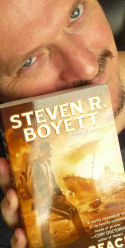
Readings are free, and proceeds from the bar go to The Variety Children’s Hospital. So far SF in SF has raised around $25,000 toward this end.

The venue is a screening room at The Variety Preview Room in the Hobart Building, and it is one of the nicer places I’ve been to hear a reading, with banked theater-style seating, sound-dampening curtains, overhead spot lighting, a congenial host, snacks & booze in the lobby, and an attentive, appreciative audience, many of whom are writers themselves.

Readings and subsequent Q & A are recorded and made available online as well.

Karen and I used to correspond many moons ago, and I hugely enjoyed seeing her again.  Her star has risen enormously over the years (a MacArthur grant, breakout literary success with Sarah Canary, commercial and cinematic success with The Jane Austen Book Club, awards, awards, awards), and it has been a delight to witness. What I like most is that none of this seems to have affected her work — she remains sui generis, she hasn’t distanced herself from science fiction as a genre, and she continues to produce intelligent, involving, and affecting work.

I had some great conversations before & after the event, and felt very welcomed (everybody seemed to know each other).

SF in SF is a terrific resource for the community, and huge kudos to Terry Bisson, Rina Weisman, and all who put forth the considerable effort in organizing it.  I’m giving a reading there on November 13, and I am hugely looking forward to it.

ELEGY BEACH Paperback has Arrived!

I will put it under my pillow and wake up smart

This showed up unexpectedly the other day and I am a happy little camper.  The wonderful Steve Stone cover translates beautifully to the mass market size (and the colors really pop on the shelf), and what paperbacks lack in durability and just plain cred, they make up for by being just plain fat.

It was also an unexpected treat to see the reviews put in the flyleaf. You tend to remember the harsh ones better than the positive ones, so seeing a bunch of really nice ones together makes me think that maybe I don’t just write good chair-levelers and doorstops after all.

The paperback contains an expanded Afterword and minor corrections from the hardcover edition. I’d like to express my thanks to my publisher’s typesetter, who did a wonderful job redoing the layout of my indulgent blank-verse section (p. 284 of the paperback, thank you veddy much) and general stylistic quirkiness.

AVALON BURNING, meanwhile, is going great guns. It’s very dark indeed and I’m loving it.

Teaching @ La Jolla Writers Conference

I will be teaching at the La Jolla Writers Conference Nov. 5 – 7. I had a wonderful time there last year (see my Feb. 2010 post about the Conference) and am looking forward to this year even more, now that I know what I’m in for. The students are sharp, talented, and demanding, and I enjoyed the interaction.

I will be recording the classes/lectures and will post them here asap after I am back.  But don’t let that keep you from attending — ya can’t throw down on an audio recording.

Here’s my schedule:

[NOTE: THE SCHEDULE HAS BEEN UPDATED. PLEASE SEE THE REVISED SCHEDULE]

Halfway Home

Certain indicators of progress

Sunday I hit my projected halfway mark on AVALON BURNING. Truthfully I don’t think the book is halfway done at all; that milestone was based on a novel of 100,000 words, and it’s clear that this book is going to be longer than that, more in line with my usual length of around 125,000 words.  Which would mean that I have about another 80 pages to go before the halfway mark.

Still, the point of benchmarks is not to be predictive but to have quantitative measures of progress, and as a measure of progress I have to say that it feels pretty cool to realize how (relatively) quickly the book has gotten here.  A month ago I was at page 50 and had only just begun my marathon sprint. I can definitely live with (and hopefully on) writing 100 pages a month.

Of course, I would rather write five great pages than 100 mediocre ones. But that mindset, while artistically admirable and full of integrity and all like dat, is exactly what has prevented me from ever trying to crank away. The few things I have published that were written in a blinding white full-throttle-down were some of the clunkiest things I have written.  (No, I won’t name them.)  But I have realized that the reason they were clunky wasn’t because they were written quickly but because they were written quickly under very tight deadlines that did not allow revision beyond a straight proofread. Every one of those (well, there’ve only been a few) was something that I would have been perfectly happy with had there been time to give them even one good going-over.

What I’m seeing with AVALON BURNING is that the prose reflects my style and will be what I want it to be upon thorough revision, and that the clunkers of awful or unclear lines or awkward staging are more like occasional speedbumps than the vast plain of rubble I had assumed would dominate the manuscript.  It’s nice to think we can play out some mythical divinely inspired artiste and craft final, finished work in first draft, but that generally ain’t how it works. Michelangelos don’t as a rule bang out “David” in a white heat of flying marble dust.  They carve out something that looks kinda like a guy and then start in on that.  Gradually making the stone fit the shape in their mind.

And though that initial carving-out can be onerous — Sunday’s writing session was like digging through a mountain with a spoon — I genuinely love revision.  To me it feels at least as creative as the initial writing, if not more, and I am hugely looking forward to leaving blue ink all over this sonofabitch when the first draft is finished. Which I’m doing my level best to be sure is sometime in November.

Road Trip in Miniature

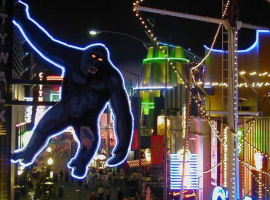
Kong sez hi

Last weekend I had the good fortune to visit Los Angeles on the hottest day ever recorded. It’s literally 118 degrees and I’m in the concrete monstrosity that is City Walk in Universal City sitting outside a Starbucks and drinking a large hot coffee and wondering why tourists are looking at me as if flags and cuckoo birds are coming out of my ears. But it was great good fun to run around City Walk with a notepad and camera and take pictures and let the place itself tell me how events about to transpire in AVALON BURNING should happen there. City Walk has become even cheesier and more rundown that it used to be, and I cannot wait to put the postapocalypse whammy on the joint.

I was disappointed (but hardly surprised) to learn that UCLA Extension no longer operates a campus there (in fact they seem to have shut down many of their locations throughout LA). I loved teaching writing at City Walk — it was surreal as hell to meet students for coffee before class when firewalkers and jugglers and ogling tourists were going by, and sometimes I had to stop lectures while marching bands or loud performers went by in the street outside.

Dave sez hi
Dave sez hi

I got to partially pay back my friend Ken Mitchroney for all his work helping me move to the SF Bay area by helping him move a couch to his temporary digs at Dave Schow‘s house in the Hollywood Hills. This meant getting a 200-pound couch around a Dr. Seuss-like catwalk that was not wide enough for the couch and wound around the house on three sides. In 110-degree weather. Everyone contributed ingenious solutions that worked when they were needed and I got to briefly visit with my old friend Dave. We were bestest buddies in the 80s and had a lot of adventures together. His career has burgeoned and he is a terrific writer. I used to use sections from his work when I taught classes on writing action, which I think is harder to do than a lot of writers (many of them quite lit’rary, donthca know) realize. Dave does something he calls “verb packing,” and it works gangbusters.

Ken sez hi

Road trips with Ken are always great and the five-hour drive goes by in about 25 minutes. Plus I got to have dinner and a long heart-to-heart with my friend Scott Kelley, squeeze in a lunch with my Burner buddy Kevin, and then go shopping at Ralph’s before heading back. (Ralph’s: they have things I can’t get up here. Like egg bagels. There is not an egg bagel to be found in Benicia. Or a synagogue either. But there is a Baptist church and a Mormon temple across the street from each other not two hundred yards from my house. Hmm.)

Then back to cranking away on AVALON BURNING. More on that next post.

Endings

I almost always know the ending to something I’m writing. It usually occurs to me early on, if not right away. I think good endings are important. You want to look back over the book or story and think about what led you there, and you want the important things to have been surprising when they happened but inevitable in restrospect.

Knowing the ending helps me enormously. Besides giving me a target of drama, emotion, and event (and these are not necessarily the same ending, yunnerstand), it lets me plant seeds along the way that will bear fruit later on. It gives me foreshadowing and turns of phrase and the kinds of details that mean something new and different on rereading. I like to think that people who reread my work will get more out of it on the next go-round.

The need to know the ending in advance has generally been so important to me that I have often been unable to finish something if I didn’t know the ending. I think I interpret not knowing it as a sign that the book isn’t on rails, bound for some inexorable destination, and that I will be doing some narrative casting-about until I find it.

As it seems intent on doing with virtually all of my writing habits and rituals, AVALON BURNING is proving an exception. I know very clearly what I want to have happened by the end of the book — who ends up where, and for what reasons — but the mechanics of it, the specifics of it, are not there yet. This is in direct contrast most of major scenes and details of the book already existing in my mind. (Plus, I admit, some that get added along the way as events suggest them.)

I often wonder if I should talk about this kind of stuff.  It does give readers a certain latitude to raise a hand at some panel and ask me, “So how come the ending of AVALON BURNING sucked so major hard?” But writing isn’t magic, it’s work and a continuously revising process of invention. Maybe revealing it as such takes away from some imagined mystique, or makes it hard to maintain some poetic image of an impassioned artist in a garret working as a conduit for the gods.  And you know, sometimes it really is that.  But sometimes you make mistakes and sometimes you head down blind alleys. Ultimately what counts is the final product, and having the sense to know when it is the final product and when it isn’t.

For me the fun of writing AVALON BURNING is how different from my usual methods all of this has been. I have a lot of faith in the writer part of me, and I’m not especially worried about him ending the novel in any way but what it should be. Meantime, the newness of my approach on this book has freed me to sit back and enjoy the writing of it more than usual. I’m having fun.

Notes on Writing Fast

I should hit the ostensible halfway mark on AVALON BURNING in the next week or so. Writing every day isn’t new to me by any means but writing at this pace and in such immersion every day (except Monday, which is Podcast Day) is something I haven’t tried before in any structured way. I’m enjoying the hell out of it and I’m learning some interesting and surprising things:
  • Abandoning my usual deliberateness and constant on-the-fly revision I find that my style doesn’t really seem to change. My phrasing and rhythm and idiosyncrasies are in the marrow now it seems and not some affectation layered with deliberate forethought or slathered on after the fact. I find this reassuring, as it simply verifies for me that this is how I write now.
  • I find that despite the stated goal of pushing on I still need to stop a few times a week to reread what I’ve done so that I don’t lose sight of details or continuity, foreshadowing and momentum.
  • I’m startled how much of the novel really is there the first time out.  Subtext, planted themes and imagery, hints and payoffs. It’s gratifying and a little creepy that the book entire really does seem to be already lodged in my head.
Pinstriping (photo by Ken Mitchroney)

I did take the time to do some research on hyenas. Lions can kiss my ass. Hyenas friggin rock.

Some weird details and surprises that have emerged in the narrative:

  • Centaurs have a violent reaction to coffee
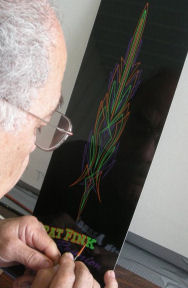
  • Centaurs pinstripe their didgeridoo/spears
  • I am about to make downtown Los Angeles one scary-ass place to be (can we take the “it already is” comments as read?)
  • I am in love with Avy. (She was a minor character in ELEGY BEACH and is the protagonist of AVALON BURNING.)
A better life awaits you offworld at Universal City Walk!

I am heading down to Los Angeles this weekend to visit friends. Part of my mission is to run around Universal City Walk with a camera and a legal pad and take my usual frantic and maniacal notes. It’s gonna be fun to Change-ify City Walk because I just hate the place. I used to teach there. Perhaps the most surreal thing about it is that there’s a UCLA Extension campus there, fergodsake.

Ch-ch-ch-ch-changes (pt. 2)

Yeah, okay, so:  writing.

I have usually gone through periods of feast or famine in my writing (well, in my life, too, but that’s another story — isn’t it?). I would work sporadically on a project at the beginning, nudging it around, sniffing out its edges, figuring out what sort of beast it wanted to be.  At some point the thing would either not become something and I would move on, or it would find itself and take hold, and I would work more diligently.

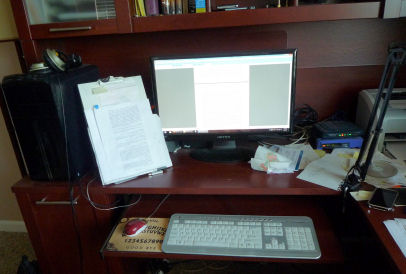
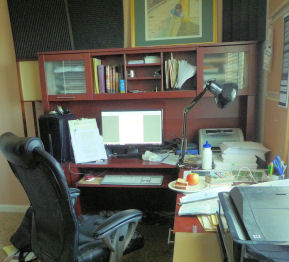
This is my desk, here mostly to break up this insanely long post.

My pattern for many years has been to go to a coffee shop with a pen and a yellow legal pad and write a few pages.  I would come home and transcribe them into the computer (I am a staunch WordPerfect user and believe MS Word is a hideous infection foisted upon an ignorant world eager to settle for crap so long as it is free crap; I say this not out of blind loyalty but as someone who earned a living as a professional word processor for lawyers, doctors, and universities for a very long time).  I’d revise the handwritten draft as I typed it in and then I’d print it out.  Next day I’d bring those pages to the coffee shop, revise them, write new stuff on a yellow legal pad, and then come home, enter the revisions and the new stuff in the computer, and repeat the process.  I tried to do this every day but of course life gets in the way.

I would have long spells where I got stuck.  I’d painted myself into a corner, or I required something in the book about which I was ignorant and I’d stop and do a ton of research and then go on.  Sometimes I would be surprised to find I was simply not emotionally or experientially ready for some undertaking.  I stopped Elegy Beach for six months when I hit the latter sections with Pete, because I just wasn’t ready for it.  The writer part of me had been rubbing its hands and eager to get hold of this chewy stuff, and I was startled to realize my heart was not yet up to it.

A closer look. Note the desktop PC, copystand, monitor, mouse, keyboard. You are enraptured, no?

This process gets books done but not terribly quickly.  Add to that an ambivalence about writing that grew over the years. It temporarily resolved when I stopped writing for five years, but it came back — not when I returned to writing (because that was fun) but when I returned to trying to publish what I wrote.

(Aside: I am constantly confronted with misinformation and assumptions about my career and biography. The easy public perception is that I published two novels and then quit for twenty-five years but felt that somehow the world needed a sequel to Ariel and so returned to writing. The truth is more complex and more interesting:  I stopped my career dead in 1986 in my mid-20s by buying back a novel from a publisher in a dispute (The Geography of Dreams, which was to be the continuation of The Architect of Sleep, about which do not email me). This was a dramatic, triumphant, and idiotic move that fairly cost me my career. More victories like that and you lose the war. I continued writing all kinds of things, and during this supposed dry stretch I wrote ten novels, four feature screenplays, comic books for Marvel, and I don’t know what else. I did not even begin learning to DJ until about 2000; the bio detail that I left publishing to pursue it, which I continually encounter in reviews and online, somehow manages to avoid that 14-year gap between 1986 and 2000. It’s just that people don’t see you on the one shelf in their bookstore that they look for you in, and therefore you must have fled or quit. Harlan Ellison once told me I’d had the damnedest career.  I’m sure he meant the pun.)

Okay, so what about now? What about all this change?

When my Acer recently went kerflooey (see previous post) and I used the opportunity to repair it and make it my standalone music station, I bought a nice new Core i5 tower and a very nice monitor and upgraded from XP Pro to Win 7 and looked at the tabula rasa of that hard drive and though about the opportunity it presented to build from a new foundation.  I didn’t realize that I was wanting this in ways that had nothing to do with computers. And after I dialed in the new PC I resumed working on Avalon Burning, the new Change novel, pretty much as I had always done.

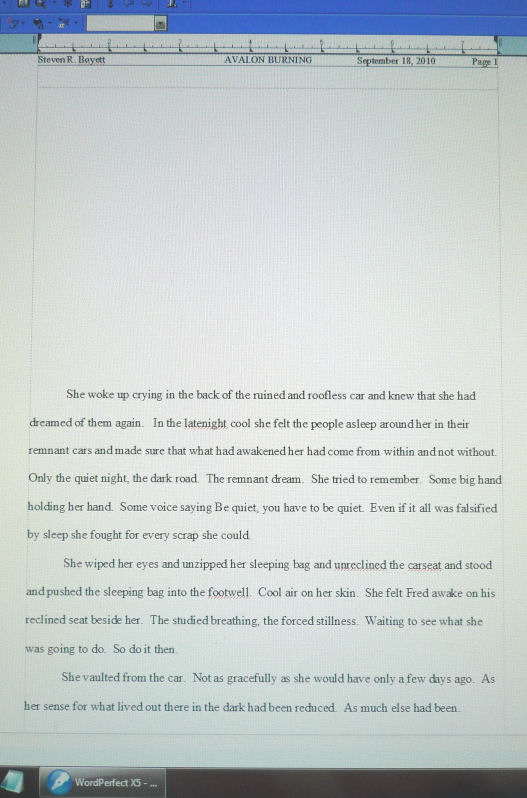
First page of Avalon Burning. You can click it and read it if you want.

I reread what I’d done and liked it a lot but had no idea where I was going with it. This is very unusual for me.  Once I get going I just know the book. It’s written in my head and the rest is a kind of transcription. I become amanuensis to myself. It’s weird but hardly unique.  But here I was with this book underway and not only did I not know its destination, I wasn’t even sure what kind of vessel I was on.

Then one day I was at the coffee shop and staring at the pages and it just opened up.  The whole thing expanded and organized and established itself, bedrock, framework, walls, and decorations.  I couldn’t believe it.  It was like buying an empty lot and staring at it until a house inflated from the ground.  It was one of the happiest days I’d had in a long time.

I decided to try to write it in a month.

That means ten pages a day, every day, and that’s for a novel about 25% shorter than I usually write.  That means no coffee shops, no stopping for massive research.  It means damn the torpedoes and full speed ahead.  It means being perfectly willing to write embarrassingly bad prose and laughably ignorant facts.  It means not indulging myself the way I usually do by taking trips to depicted places and making notes and taking pictures and immersing myself.  In the case of Avalon Burning this isn’t a problem because I’m pretty familiar with the places I’m writing about.

The thing is, writing is important, but revision is crucial. In many cases it’s where the real artistry emerges. The flow of events, the meter of sentences, trimming down excess, tightening structure, maintaining continuity, interspersing lines and images and events that maintain themes.  I love revision, and I’ve even taught classes about how to revise. It helps writers to know that it’s okay to suck on your first draft. No one will read it. No one has to see you flopping around in your underwear and Godzilla slippers. You’re gonna take those pages to the gym and get them in shape and put them in good clothes and take them somewhere nice. But first you have to have the pages to work with.

I’ve fantasized all my career about writing a book in a ridiculously short time.  It just has a speed-driven, burned-at-the-edges, fanatical obsessive impassioned appeal. It’s romantic and stupid but there it is.  Kerouac did it, Phil Dick did it constantly, Dave Schow used to tell me it was fun to challenge himself to do it.  So hellwiddit.
I locked myself in my room and started banging out.  Now let me be clear:  I am not making my quota and am not going to get this book done in a month.  First of all because it’s clear it’s going to be my usual 125,000-word length or so. Second because I do have to deal with other stuff, and the romance of sealing myself in a tower with a bottle of wine and a crusty baguette and a roll of butcher paper threaded through my Smith-Corona just isn’t realistic.

So maybe it’ll take me two months. I’m okay widdat.

I’m in the middle of it right now and I am having an absolute god damned blast.

I don’t usually talk much about books I’m working on (I have a bunch of reasons, but one of them is that they don’t always end up published, yuckity yuck yuck), but I think I will be reporting in on this one. Hope you enjoy the dispatches.

Ch-ch-ch-ch-changes

I have of late, but wherefore I know not, felt a growing hunger for change.  Complacency is poison to me, which can be both motivating and detrimental. I simply don’t like to be still. I can do it, and enjoy it, but not for very long. I’m a lot of fun on the kind of hell-bent-for-leather vacations where you try to eat as much of some new place as you can in the time you have. But if you want to sit in a chair on a beach for five days, I am a nightmare. I don’t know what to do with myself.

My life recently had begun to feel like those five days on the beach. Now, I don’t expect anyone to say, oh, poor Steve, his life is a beach vacation, I bleed, I tell you.  This is not an entry about comfort.  This is an entry about how my mistrust of comfort leads me to do things.  For better or worse, I’m one of those Type-A Captain Kirk people who thrive on challenge. Who produce their best work under adversity. And who do nothing but stew, bitch, and stir up trouble when things get quiet.

Things have been quiet. Well, not so much quiet.  Things were too much the same. Not going anywhere. Maintaining.  I don’t want a life of mere maintenance, even though that means dealing with more of what life throws you. I’m not an adrenaline junkie but I certainly prefer to take risks and fail than to simply … maintain.

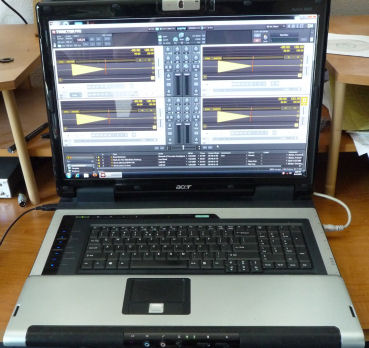
21" Acer 9800. I love this thing.

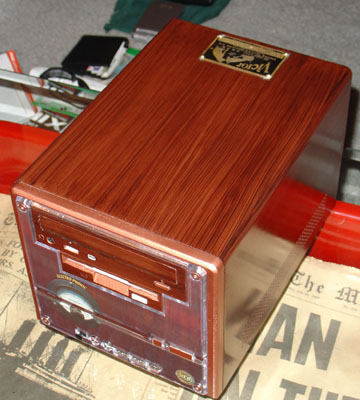
Since my beloved Acer 9800 21″ dual-drive laptop went (temporarily) the way of all silicon when the video chip on the motherboard went cough-cough, I took advantage of the opportunity to get a newer Core i5 desktop and a wonderful 23″ monitor (the Acer had been a desktop replacement). Then I spent months combing the earth for parts to fix the Acer. Once that was done (and a Homeric task it was; big shoutout here to Laptop Rescuer in Santa Clara, CA), I repurposed the Acer as my all-in-one home studio hub. Before that I’d been using my cherished but ancient Shuttle XPC, which I  customized to look something like an old radio. (I have a thing for trying to turn the machines on which I produce my creative work into creative works themselves.) I have produced Podrunner and Groovelectric and many of my compositions on the Shuttle for years, but software capabilities have passed it by, and the poor thing just couldn’t handle the functionality of newer music programs.

My customized Shuttle XPC. I love this thing.

I was probably one of the last DJs to be using Native Instruments’ Traktor DJ Studio version 2.5.3, sophisticated as hell when it came out, but dated now. For a while now I have felt creatively frustrated, and have wanted the capability, flexibility, and innovation offered by the latest version, Traktor Pro, which offers four decks, a buttload of effects, and a four-band EQ. This changes the idea of mixing from simple transitions from one track to the next (and maybe some fancy cutovers and tricks) to literally remixing tracks and minutely sculpting the sound on the fly. I have tried the versions of Traktor subsequent to 2.5.3 but found them buggy, unstable, or simply unusable for my needs. But I’m delighted to say that, despite some reservations and a few complaints, the latest update of TPro seems to work for me.

Traktor Studio v2.5.3. I love this thing.

So I upgraded to Traktor Pro and Windows 7 Ultimate, upgraded my post-production software (Sony Sound Forge Pro 10), put away my amazingly rare and wonderful Faderfox DJ1 MIDI controller, dug out my amazingly rare and wonderful Bitstream 3X MIDI controller, and spent literally a week listening to thousands of tracks to resupply my Podrunner and Groovelectric inventory.

Then I set out to learn. I complain, I pound, I make up swear words.  And I learn.

And I immediately began producing some of the best stuff I’ve done in ages. And found my interest in DJing revitalized, my focus acute, and my enthusiasm for future mixes rekindled.  The listener email has certainly reflected it; people have noticed the difference. I am taking things slowly and trying out new functions and possibilities a little bit at a time, but it already seems worth all the hassle.

Traktor Pro. I hope I get to love this thing.

So next I turned my attention to writing. Ohhhh yeah. More on that next post  (and I promise it won’t be four months till then).

First New Story in a Decade

Cover of the first Subterranean anthology

Subterranean Press will be publishing my novelette “Not Last Night but the Night Before” in Subterranean: Tales of Dark Fantasy 2, edited by Subterranean’s own Bill Schafer. The hardcover will be published January 2011; the limited edition will feature full-color art not in the trade edition and a chapbook of two original short stories by the truly amazing wild talent Joe R. Lansdale.

I’ve written earlier in this blog that I really miss writing shorter work. I used to only write short fiction and swore I’d never write a novel. We all know how closely I abide by such vows. Usually when I don’t publish for a while, people assume I haven’t written anything, which is often far from the truth.  I’ve probably written a bunch. I just don’t talk about it here because it doesn’t always end up published. My career’s funny like that. F’rinstance, I turned in a new novel last week. Have I talked about it here? Hellno. Cuz it might not show up, and then what do I say? Oh, sorry, do-over.

But in the case of short fiction I haven’t published any because I haven’t written any in a very long time. I jumped at Bill’s flattering invitation, and used it as an opportunity to dig out one of the two last short stories I’d started and left unfinished quite literally over a decade ago. The other one I still might do — it’s a killah — but “Not Last Night but the Night Before” was one I’d really wanted to finish but had gotten absolutely stuck on. I didn’t know how it ended, which is very unusual for me. I almost always know where these things are going.

But perspective is generally a Good Thing: I read the unfinished story, made some notes, and had the ending staring me in the face. Duhh. Sometimes ya just gotta let ’em brew for a while.

Subterranean produces absolutely beautiful editions, and Shafer’s editorial acumen is up there with the best of them — which is why I’m so tickled to have been asked to contribute to a collection in which I will be in some very good company indeed. Check out this table of contents:

  • Joe Hill – Wolverton Station
  • Kelley Armstrong – Chivalrous
  • James P. Blaylock and Tim Powers – Untitled
  • Steven R. Boyett – Not Last Night but the Night Before
  • Glen Cook – Smelling Danger
  • Caitlin R. Kiernan – Hydraguros
  • Jay Lake and Shannon Page – The Passion of Mother Vajpai
  • K. J. Parker – A Room with a View
  • Norman Partridge – Vampire Lake

Around  November or December I’ll bring out a PDF of the story’s first act. It’s sort of a Tim Burton foreign movie that’s very dark, very funny, and strange as hell. Naturally I’m quite fond of it. According to Bill it’s “an affecting reflection on love, death, and acceptance.” Well, golly.

SoCal Writers Association (part 2)

Here’s the second talk I gave to the Southern California Writers Association on May 15.

This one’s about the changing roles and even nature of authorship in the digital age, and the way digital media affect our notions of copyright and intellectual property, and therefore the business models that have been axiomatic to most writers their entire lives. A much more contentious issue than the first speech, and therefore a much more fun one to give.

SCWA members weren’t shy about chiming in, either, which I just loved.

[audio:http://www.steveboy.com/audio/scwa_-_new_takes_on_copyright_and_authorship.mp3]

Download “New Takes on Copyright and Authorship”

Either we're praying or I'm trying to remember the lyrics to "The Star-Spangled Banner."

SoCal Writers Association (part 1)

May 15 I spoke at the monthly meeting of the Southern California Writers Association in Fountain Valley, CA. The first topic was “Writing and Publishing in the Digital Age.”  Here’s the talk (1 hr. 6 min.):
[audio:http://www.steveboy.com/audio/scwa_-_writing_and_publishing_in_the_digital_age.mp3]

Download “Writing and Publishing in the Digital Age”

I’ll put the second talk online when I’m back from Los Angeles after Memorial Weekend.

Dream On

I have amazing dreams. I consider myself very fortunate, as I know a great many people who tell me they don’t remember their dreams well, or dream in dissociated fragments that don’t cohere, or have dreams that seem irrelevant or insignificant or just plain dull.
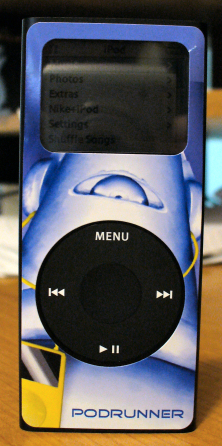
I tend to dream full Technicolor $500-million special-effects-laden Hollywood extravagonzos, which can be a Bad Thing if you tend to have nuclear holocaust and plane-crash dreams (which I used to have quite frequently, but which have abated in recent years, a lessening I attribute either to the zeitgeist or to just not being so damn worried anymore). I’ve dreamed stories that I’ve later written (my short story “Emerald City Blues” came from a dream of Dorothy Gale’s house landing on a plain of green glass). I’ve dreamed I was in the middle of scenes from novels I was working on, or that I’ve had conversations with the characters. Those are wonderful dreams.

After my father died I dreamed I was waiting for a train with him at Union Station in Los Angeles, and when it arrived it was this great sleek black Art Deco train and he got on it and waved as it left the station, and I woke up crying and happy with the understanding that I associated my father very strongly with the Great Depression, and that I’d just had my own private goodbye and bon voyage.

I woke myself up laughing one night after I dreamed that Mattell was going to be producing a Tourette’s Syndrome Barbie.

When I wrote The Architect of Sleep I did a lot of research on dreams (oneirology, for y’all nomenclaturists), and I kept a dream journal. I found that the more I wrote down my dreams, the more clearly I remembered them from night to night.

I’ve had serial dreams a lot of times, where some subsequent night you resume a dream where you left off. I’ve read some speculation, though, that this is a neurological phenomenon similar to deja vu in which the brain thinks it’s resuming a previous dream and can remember the earlier scenes, but no prior dream really exists. It’s an artificial memory within the artificial experience of the dream itself (good lord, we’re in Philip K. Dick land every time we close our eyes!). I’m inclined to think this is true because it provides a neurological explanation, but leave it to neurologists to take all the fun out of everything.

I’ve also had a lot of dreams where I remembered that I’d written a novel some years ago, and found a way to rewrite it that would really make it fly, and I’ve even awakened with the title in my head and gone to look for it only to realize moments later that of course I’d never written any such thing. Now that’s friggin disconcerting.

More about this tomorrow.

Here Comes the Run Again

One of the great ironies of my popular Podrunner podcast of fixed-BPM workout music mixes is that, in the last year and a half or so, I have been so busy splitting my time between producing it and working on novels that I’ve had very little time for exercise. For most of the last couple of years I’ve gotten by on about four hours of sleep a night.
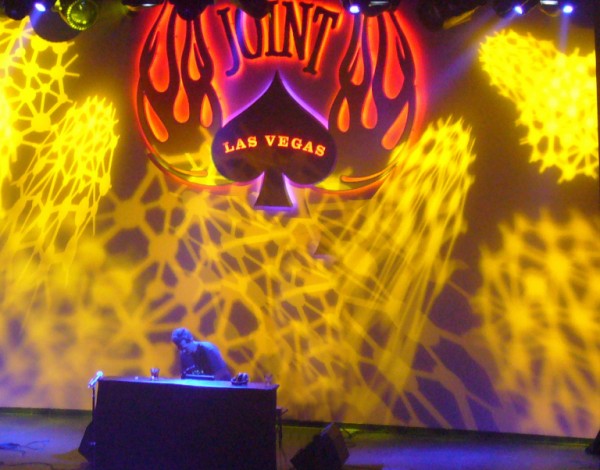
Now that the novels are published and we’ve moved to the SF Bay area, things have settled down a bit, and one of my resolutions has been to get back to working out. Not exactly great PR for the Podrunner guy to be a large soft doughy thing. In a year and a half I’ve gotten laughably out of shape. I miss doing yoga (well, actually I miss martial arts, but that’s another story. Yoga is a wonderful substitute; it’s like slow-motion martial arts).

I’d say I’ve missed running but that wouldn’t be the truth. The evil reality is that I really don’t enjoy running all that much. I’m not remotely built like a runner; I have a long torso and short legs with disproportionately strong quads that burn oxygen like mad. I run a mean 50-yard dash and then I’m done done done.

But I started up again about two weeks ago.  Ye gods.  When I was doing this regularly I was doing three miles three times a week. Clearly 18 months ago was the halcyon days of my vibrant youth, cuz two weeks after taking up running again I’m up to two whole miles, and an ugly two miles it is, too. And the only thing that gets me through this, funny enough, is the Podrunner and Podrunner: Intervals mixes. Exactly because I’m not crazy about running, there’s no way in hell I’d be out there doing it without the fixed-tempo music (and electronic dance music at that, which is always Fine By Me).

So I don’t just own the company — I’m also a client.

Digital Writes

My guest post, “The Schlock of the New,” on Richard Curtis’ wonderful E-Reads blog is now online. E-Reads is essential reading for anyone who wants to stay abreast of new innovations in publishing. This is the first of my “Digital Writes” series of guest posts for E-Reads centering around New Media and the implications and effects of new technology on writers, readers, and publishing in general under the rubric “Digital Writes.”

This first post is a smartassed epistolary (two words I’m suddenly delighted to use together) addressing the god-given right to stay working in a trade that is assumed — not coincidentally — by the practitioners of that trade. Those poor slide-rule makers. We really did screw them out of existence.

Gigsville

I have a kind of weird history as a DJ. I didn’t come up through house parties and then bars and then small clubs to larger clubs, which is the fairly normal route. I went from house parties to megahuge podcasts to clubs and conventions. More people download my mixes in an average month than the most popular DJs will play in front of in the same period, but because I didn’t come up through typical channels, club promoters and other DJs don’t have any idea who I am (and why should they), so my gigs tend to be intermittent. I’m the Rene Magritte of DJs: My work is pretty well known but nobody knows who I am.
I’m not remotely putting on airs about this. Downloading free mixes and paying to hear a DJ at a club are two very different things. My name at the top of a club flyer ain’t gonna pack ’em in. And I’m not really frustrated by it, either. I’m a really good club DJ, but believe me when I say that I’m aware that John Digweed has earned his status as a major club headliner in a way I never will.

All of this is preamble to saying that, after playing conventions and Vegas clubs and some smaller but well-known Hollywood clubs, I played my first-ever bar gig last Thursday, at The Rellik in Benicia, California.

Bar gigs are a very different animal. At a club people expect the DJ to guide the night, to read the tone of the crowd and reflect that in the music and then take it somewhere. A club DJ gives the night a sense of structure. He tries to take the room on a kind of journey.

Bar DJs are generally viewed as a kind of meat jukebox. People come up to you and say “I want to hear Beyonce,” and at some point soon you’re supposed to play Beyonce. A bar DJ who looks and acts like he’s spinning at Pacha in Ibiza is going to look like a jerk and bomb like a Rush Limbaugh sitcom.

Nonetheless I have no preparation for how to react when confronted with The Beyonce Question. In the first place I don’t own any Beyonce. In the second place I can’t imagine a situation where I’d play it. The bar owner wants a DJ night with a housey, laidback club vibe, and I spent the night playing funkyass house tracks with a retro Parliament Funkadelic / Sly Stone kind of sound (sort of my trademark) and remixes of pop from the 60s through the 90s. Here are some dialogue exchanges from the evening.
“Are you going to play something that isn’t techno?”
I haven’t played any techno. But what would you like to hear?
“Michael Jackson.”
The song that’s playing right now is a remix of “Thriller.”
“Oh.”
======
“This is techno. Don’t you have any music people know?”
The song that’s playing right now is a remix of “Don’t Stop Believing,” by Journey.
“Oh.”
======
“Why are you playing all this pop? Don’t you have any dubstep or techno?”
See those people over there? Go ask them. They asked for pop and no techno.
“Well, don’t you have anything with more bass in it?”
I’m the first DJ here who’s ever brought subwoofers. Any more bass and we’ll be breaking glasses.
“Well, if you knew what you were doing your dancefloor wouldn’t be empty.”
Dancefloor?
=====
“Hey, play some rap.”
The description for Thursday nights says no rap, no hip hop.
“Then play some hip hop.”
=====
“Let me see your playlist.”
There isn’t one. I have five thousand tracks with me. I make it up as I go.
“Well let me see them.”
No.

=====
“Can you play Michael Jackson?”
Sure. Give me about 15 minutes.

“Why haven’t you played Michael Jackson yet?”
Because you asked me three minutes ago.

“When are you going to play Michael Jackson?”
This is Michael Jackson

“This is GAY Michael Jackson.”
So then it’s Michael Jackson. I’m also playing the black Michael Jackson. Is that not okay?
=====
And my hands-down favorite:
“It’s really hard to drink cabernet to this music.”

For a while it seemed that the lesson I learned was that bar DJing is a kind of boxing match. Then I found out that in fact most people enjoyed the night, and the bar owner asked me to play every third Thursday, so I landed a monthly gig. So I think the lesson is what I call the Amazon Review Effect: Your perspective is skewed because people who have a problem with you are more likely to say so than people who like you, who generally don’t feel obliged to tell you that they do.

Or at least this is the lie I tell myself that lets me get through whatever book I’m currently writing.

Saturday Morning at Steve & Mo’s

Maureen is wrapped in a blanket on the easy chair in our living room, drinking coffee and reading texts from her halfsister about an axe found in her basement with a Frankenstein monster face painted on the blade. I’m on the couch nearby, drinking coffee and reading and slowly waking up. Or trying to read, anyway, because Murdoc is playing under the blanket where I have made a little tent space for him, which he usually finds irresistible, and I need to keep him from also eating the couch. The coffee is Peet’s Major Dickason’s, roasted one day ago and sent to us UPS and made in our hilariously Rube Goldbergian Capresso coffeemaker that makes the best coffee ever.
Alexander is on his perch in the living room watching Power Puff Girls and making cute toy-animal sounds and imitating sound effects. He loves Power Puff Girls and Dexter’s Lab.

When we are finished with our morning ritual I will catch up on email and check to be sure my Podrunner newsletter has gone out successfully. Then I’ll carve out space on my desk and in my day to work on revising Ferry Cross the Mercy, the next novel I’m turning in. Then I’ll work on my guest post for my agent’s blog.

Right now though I’m basking in the moment. In the realization that I’m happy.

Ode to the Air Shaft

Let us take a moment today to honor the humble air shaft, without whom many of our favorite filmic moments and plot devices simply would not be. The air shaft enables clever escapes, crucial infiltrations and rescues, mysterious hostile movements and attacks, convenient storage, and overheard conversations of relevant magnitude. In fact I would like to proclaim today, March 4, as International Air Shaft Day.
Whenever you see an air shaft employed to just such ends in any drama high or low, don’t take it for granted.  Raise your glass and take a moment to thank the special breed of Hollywood air shaft employed to just such clever ends. Why novelists, radio dramatists, comic book writers, playwrights, and other, less innovative media scribes have failed to recognize the miraculous qualities of this engineering marvel is quite beyond me.
For the Hollywood air shaft is accessible with a makeshift screwdriver or simple banging with a palm, vented large enough to enter and exit, at least roomy enough to crawl through, sturdy enough to take an adult male human’s weight throughout its length, and thoughtfully sound baffled so as not to disturb occupants as its user traipses along its metal length from place to place. Without the highly evolved and carefully engineered Hollywood air shaft, so many of our favorite films, classic and otherwise, would falter, requiring their creators (if you’ll pardon the exaggeration) to concoct some hitherto unexplored means of sneaking from place to place within a structure.

Why has the humble air shaft gained predominance over the the lesser employed but similarly convenient, accessible, and roomy sewer drains that clearly pervade Los Angeles (and thus by extension the remainder of the civilizable world)? I submit that our arboreal roots (yuck yuck) take precedence. We weren’t conscious when we rose from mud but we were getting there when we began to swing from tree to tree.
For the same reason we should honor the myriad films whose heroes and villains duke it out at the top of a building or analogous structure , often a framework under construction, to establish for the other primates who the real alpha male is after all. Here’s to you as well, framework building or analogous structure! Long may you wave — for certainly long shall you.

We Have Ignition

It’s taken me longer to settle in and adjust than I figured (unusually optimistic of me, wasn’t it), which is one reason my posts have become a bit sporadical lately (no, I haven’t blogfaded), and I’m just now starting to get involved in local events and suchlike. On Sunday I went into San Francisco with my friend Scott, who is visiting from L.A.. It was the first first clear and sunny day since Maureen & I moved up here a month ago. It felt like spring and the whole city went outside. Golden Gate Park was bustling and fun, and god knows I ate too much. When I worked for Pixar some years back I gained 12 pounds in three months, largely because I couldn’t resist the many great restaurants of San Francisco.

Today I’m headed to the city again to attend Ignite, O’Reilly Media’s
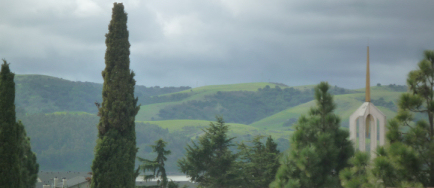
high-energy evening of 5-minute talks by people who have an idea—and the guts to get onstage and share it with their hometown crowd. Run by local volunteers who are connected through the global Ignite network, Ignite is a force for raising the collective IQ and building connections in each city.  And, via streaming and archived videos of local talks, local Ignites share all that knowledge and passion with the world.

It’s part of Global Ignite Week, and I think it will be fun. It’s a great way to meet people in an area largely new to me, and to see what sorts of interesting things are going on hereabout. Los Angeles has a similar monthly event called Mindshare that I highly recommend.

LJWC & My Favorite Class

I delayed writing about my experience at the November 2009 La Jolla Writers Conference until audio of one of my classes/lectures was available (see below). The annual conference is held at the Paradise Point Resort & Spa, just north of San Diego in a weirdly Pacific Island-ish location you’d never guess was there.

Conference teachers and speakers donate their time and expertise. To be honest, when I discovered this I was a bit put off — everybody wants something for nothing, and everybody thinks you should be delighted to freely lend the time and talent that pay your rent in exchange for some nebulous and unsubstantiated notion of “exposure” (see 3/4 of the services ads on craigslist, for example).  My usual response to this sort of thing is to say, Tell you what, you come to my house and mow my lawn for free, and I’ll tell everyone how good you are. Feel free to bring busines cards. But I had a novel coming out and was in PR mode, and it had been a while since I had taught and I wanted to jump back in.

I’m delighted to report that I had a terrific time at the LJWC. It was well-organized and offered a curriculum beyond the usual “how do I break in?” fare. Teachers were working professionals who seemed to know their stuff, and were quite dedicated to the tasks at hand. Conference staff were wonderfully accommodating, even redirecting a scheduled class to another room when a class I was teaching (audio below) went over time but wanted to keep going. I have grown skeptical of events and publications purporting to help beginners but whose stock in trade is really a kind of carrot-dangling before a hungry constituency.  Such was clearly not the case at LJWC; it was apparent that revenue taken in for the conference went straight into the conference itself, and into organizing the next conference.

But I was most impressed by the students themselves.  These weren’t people who thought it would be cool to be a writer, or who treated it as a hobby.  These people were dedicated to career and craft.  They knew their stuff, and they were demanding and challenging. As a teacher and lecturer I was in heaven; it meant I didn’t have to keep everything basic , that I could run with ideas and build high from a solid foundation.

So I can heartily recommend the La Jolla Writers Conference to all. What they do is a Good Thing, and they are amazingly devoted to it and professional in their delivery (though they better have coffee available to teachers in the morning next year or I will initiate a friggin coup). LJWC will remain the only conference to which I will donate my time as a teacher. Homey gotta eat, ya know.

Besides teaching classes on craft and technique, I was the New Media maven at the conference. For years now I have been steeped in podcasting, and the digital media revolution in which we are now well immersed has reshaped my thinking about everything from intellectual property to business models to the form of the book itself, and I have been on something of a crusade to make writers aware of what’s coming — what is, in fact, now here. My delight in discovering, only a few years ago, that there was an entire movement and literature already devoted to these subjects (collectively called, for purposes of conversation, “copyleft”), and that it was remarkably congruent with my own thinking and presentations, was pretty dang intense. Forward-thinking individuals such as Cory Doctorow, Lawrence Lessig, Chris Anderson, Clay Shirky, and others, have been tirelessly working not just to describe the emerging landscape, but to shape it.

What astonishes me about the class lecture below, ostensibly on “New Media Alternatives to Traditional Publishing,” was the degree to which the publishing landscape has shifted toward what I describe since I taught this session only last November. Throughout the talk I keep insisting on the fundamental level of change that writers, readers, and publishers are going to see within the next two years at most. Reviewing the audio before putting it online, it was a little freaky to realize that a great deal of what I insisted is coming showed up on the horizon in only three months.

Though I have spoken extensively about these topics in recent years — at Barcamps, podcasting conventions, science fiction conventions, writing workshops, and the like — I have actually written very little about them. I’m not really sure why that is. Maybe because people who ask me to come talk somewhere are listening even if they disagree, whereas lengthy blog posts (such as this one!) are just another squawking bird on the digital beach. I dunno.

In any case, below is the 98-minute session. It covers a lot of ground, and it becomes one of the best sessions I’ve ever conducted.  Many thanks to Jared Kuritz of LJWC for making this available.

[audio:http://www.steveboy.com/audio/boyett_-_new_media_alternatives_to_traditional_publishing.mp3]

Download “New Media Alternatives to Traditional Publishing”

Back in the Saddle

Well, the move went smoothly, and friends in L.A. and here in the East SF Bay worked like mules to get us loaded and unloaded. I feel lousy that I don’t have pix to post. My friend Ken Mitchroney posted a ton on Facebook, and as I am not a Facebook member I don’t have links and such. But to everyone who helped, my deepest gratitude.

Maureen drove up with the birds a day ahead of me. My friend Adrian and I slept in the empty L.A. house and took the truck up early next morning. The drive up the 5 is usually one long snore through the San Joaquin Valley, an unvarying straightaway bordered by bland brown hills. But the entire west coast had been deluged throughout the previous week, and the hills were emerald green all the way up.

View from my office
View from my new office

Maureen and I lived in a fairly small place in L.A., with literally half our stuff in the garage waiting for when we lived in a bigger & better joint. The old house must have been some kind of clown car, because we not only filled the biggest U-Haul truck available, I had to rent a trailer at the last minute to accommodate what wouldn’t fit in. The new house had seemed unfillably huge before we moved in, and yet we’ve filled it up to a surprising extent. I can’t believe we’ve had this much in storage. And now I get to open boxes and actually use things I haven’t even seen in two years. O Bliss.

My first order of business whenever I move is to set up my office. I’m sure there’s some pissing-in-corners territorial monkey emotional security aspect to this, but it’s also a matter of practicality: If I wanna stay in the house, I better get to working in it asap. So the new writing desk is set up and the audio desk is set up on the other side of the room, and I’m going through the lengthy process of dialing in the room acoustics (my first mix here was a friggin joke; thank god no one will ever hear it) and then sorting piles of files and gear and crap.

Collaborating again at last

I’ve already turned in new Groovelectric and Podrunner mixes, and am cranking away at the stories that are due in (ulp) two weeks.

Our third night here I was awakened by a weird noise. I realized it was an owl in the back yard. The next night it was the same owl (he’s here every night) and coyotes in the hills behind us. And it brought home what a big change this move really is for us. A week before that what woke me up was, I am not kidding, six helicopters hovering over our house, aiming tv cameras and police spotlights about a block over, and a voice on a chopper PA saying Put down your weapons and come out with your hands up. You have one minute. So it ain’t like I’m gonna complain about being awakened by hooty owls.

I can’t tell you how much I’m looking forward to Making Stuff in a place that is conducive to it, and I can’t wait to see what kind of effect it has on my work.

Tonight's sunset from the back deck

I Leave L.A.

Sunset Boulevard?  We leave it! Santa Monica Boulevard?  We leave it! (apologies to Randy Newman)

So I’m here in my new office in the East San Francisco Bay on a rainy gray morning surrounded by stuff that needs to be put away. I am using my wife’s Veriszon wireless card because, a week after we moved in, ATT still lacks the technical ability to turn on my new DSL line despite the fact that I was able to tap into the outgoing resident’s line for two days when we arrived here. Since it is clear that ATT could not pour piss out of a boot if the instructions were written on the heel, I am terminating all my service with them and going with, god help me, Comcast.

The move went amazingly smoothly, with crews of friends and neighbors on both ends who worked like pack mules and got us packed up and unloaded in record time. I can’t thank everybody enough.

We’re still setting up here (we will be for months), and I haven’t gotten back into the swing of writing and DJing. But I will on Monday, because I’m fond of little luxuries such as eating and electricity.

I’ll be back to proper posting soon as well. Meantime, here’s a parting image from Moving Day that says why I left Los Angeles better than anything I could write (compliments of Adrian Smith).